Guide to Birthright Book Series, Part 3 of 3:
Meet the Characters of the Birthright Book series:
Heroes and Villains
ALLEGORY HAS SYMBOLIC FIGURES AND ACTIONS.
 Below you can meet the heroes and villains.
- Many of them have names which are symbolic in the story.
- The theme is based on the Bible story from Genesis about twin brothers, Jacob and Esau.
- In the book, the twins are named Benjamin and Ruben.
- As the story unfolds, two contrasting cultures spring from the choices each brother makes.
Heroes
 Benjamin and Ruben Benamoz, main characters, are un-identical twin brothers. They each make different choices which lead to contrasting lifestyles. Their names are from the twelve tribes of Israel.
Joseph ben Amoz, Benjamin and Ruben’s father. Joseph’s name is also from the twelve tribes. Amoz is the same name as the father of the prophet Isaiah.
 Lorenzo Nobles. Governor Nobles loves to throw lavish cultural events; he collects art, music, and historical relics. His namesake, Lorenzo de Medicci of Italy, was a patron of the arts during the Renaissance. Lorenzo is a great admirer of Christopher Columbus, and of all things American. Nobles, of course, signifies nobility, not in the aristocratic sense, but in character.
Rebekah Nobles, wife of Lorenzo, encourages Ben to protect the birthright. Her namesake is Rebekah of the Bible, who rescued the birthright blessing from her wayward son Esau.
Allison Russell. Her character’s brilliant red hair matches her great intelligence. Her blunt truthfulness is amusing. Imagine my delight when I found that Teutonic and Swedish variations for “Allison” denote “truth”, and “noble humor.” Totally fitting!
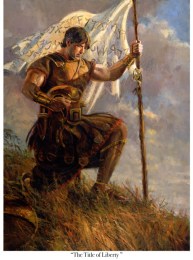 Zephan. Joseph’s older brother. His name is Hebrew, a variation of Zephaniah, meaning hidden by God; God’s treasure. Zephan’s character is like a type or symbol of Christ. He devotes his life to justice, but also is merciful. Zephan rescues the Benamoz brothers from bondage and teaches them about repentance.
Dan MacRay. A journalist with rare integrity, he founded Reality Worldview News. Dan “fights the good fight” by shining rays of light on corruption and evil. He becomes Ben’s boss in the newspaper business.
Villains
Ramses. Gandikon pirate chief who engages in human trafficking. His namesake, Ramses, was the pharaoh of Egypt who opposed Moses, made slaves of the Hebrews, and killed all Hebrew babies in attempt to stop the prophesied deliverer from carrying out his mission.
Members of the Anti-Hate Committee
 Alger Rotcraft. This is a play on words. “Rot” [rhymes with vote] is the German word for red; craft means to make. Red is the color of communism and socialism. Of course, in English, one meaning of “rot” is to become morally corrupt. Rotcraft is from the Khazarian Empire, which represents all the tyrannical isms. Rotcraft makes cultural rot. With his extreme wealth, he buys up newspapers so he can stifle freedom of speech, and pays for mobs to riot against innocent people. Rotcraft has a counterpart in real life who carries out this cultural Marxism. When you read the news, see if you can figure out who Alger Rotcraft represents.
Feral Hamad. Feral means fierce or wild. Hamad is a variation of Haman, who in the Bible tried to wipe out the Jewish people. Feral is extremely racist, and he founded Parents Legal and Youth services, or PLAY, which is a franchise of abortion clinics. I’m sure you know what counterpart in real life PLAY represents. Feral Hamad reminds Benjamin of a vulture.
Arch Kingerman is an archetype politician. His name is derived from a group in Native American history called the “king-men”, who always sought to overthrow liberty.
Elidor Redmund is ambassador to the Kohor Empire in Book 1. In Book 2, she is secretary of education, in charge of “re-educating” the people of Yeshurun. Her surname means “red world.” She is in love with Arch Kingerman.
Fomentio Dagon is a community organizer. He always foments, or stirs up, people to hatred and mob action.
Other Followers of the Order of Khazar
 Raul Dagon. Son of Fomentio Dagon. He is a “friend” who always gets Ruben into trouble.
Delia Matagorda works for Alger Rotcraft. Delia uses her seductive and deceptive powers to damage Ruben’s moral compass. She is like the Bible story of Samson and Delilah. She ends up being deceived herself.
Nils Marlow. Atheist professor at Amulon University. Believes in nihilism[1], junk science and his own delusions of grandeur.
Boris Volkrusher works for the Kohor empire, in charge of drug cartels and assassinations. He takes delight in crushing folks, literally and figuratively.
Tyro Vulcan, thug, works for Volkrusher.
 See Reviews, More about Book 2, Culture War Games HERE
 See Reviews, More about Book 1, Escape to Faith and Freedom HERE
[1] Nihilism—a: viewpoint that traditional values and beliefs are unfounded and that existence is senseless and useless b: a doctrine that denies any objective ground of truth and esp. of moral truths

 And these words, which I command thee this day, shall be in thine heart: and thou shalt teach them diligently unto thy children, and shalt talk of them when thou sittest in thine house, and when thou walkest by the way, and when thou liest down, and when thou risest up. ~Deuteronomy 6:6,7
 AT THE MERIDIAN OF TIME, people followed Jesus everywhere, irresistibly drawn to His message. Whether they were few or many, each walked away with that portion of the bread of life that fed his own soul, having connected at last with his divine heritage.
 We can use this same simple means of teaching biblical values to our family today.
 And he shall turn the heart of the fathers to the children, and the heart of the children to their fathers. (Malachi 4:6)
 Parents, This is about YOU, and Your Family
 All thy children shall be taught of the Lord, and great shall be the peace of thy children. ~Isaiah 54:13
 The story in Culture War Games shows your teenagers what it’s all about.
 Click here for your copy of the ultra-relevant historical novel,
 Patterns in History. S
 The people Built a Tall tower called The Tower of Babel
 Prince Mulek (son of Zedekiah)
 The Supreme Court
 Time to reclaim our sacred heritage
 How do we make the Biblical worldview stick with our youth, amidst all the worldly deceptions assaulting them?
 Our truly native language
 We will need to look beyond our phones, beyond worldly distractions, to the Big Picture.
 See Reviews,
  See Reviews,
 The Bible, the word of God. After thousands of years, the Bible remains the chief and most widely read of classic literature. What makes it an enduring best seller, past the peak of three weeks, six months, or even a year? Why is it never really obsolete? Because God’s truth is absolute; it never changes. It is an anchor for our souls. The Bible contains God’s commandments. If we keep those commandments, we have a covenant with Him. That covenant will bless us and keep us safe.
 Yeshurun. The Birthright Covenant trilogy is set in a microcosm of Judeo-Christian culture called Yeshurun. The biblical spelling is Jesurun, Hebrew for upright and righteous (Deut. 33:26), and chosen (Isa. 44:2)
 Anti-Hate Committee. A cabal with the principal purposes of re-writing history, ruining innocent people with calculated smear campaigns, and covering up Kohor atrocities. A front for drug cartels, financial fraud, genocide, and Gandikon crimes.
 See Reviews,
 Fantasy, though entertaining, is false. Allegory is art— a journey through layers of truth. Escape to Faith and Freedom, an allegorical journey set in the story of Judeo-Christian heritage, offers relief to families seeking freedom from the world’s dystopian, soul-threatening culture. Readers will discover that eternal truths of the Judeo-Christian cultural way of life are especially relevant to today, for all ages, generation to generation.
 historical fiction trilogy, provides an allegorical journey in a historical setting, with the eternally relevant theme of Freedom vs. Tyranny. Allegory has symbolic figures and actions, which is why it has layers of meaning.
  Christopher Columbus, a Jewish convert to Christianity, seeks lost tribes of Israel, discovers America.
 George Washington and Founding Fathers create the Constitution and establish America as a covenant nation.
 Abraham Lincoln restores the covenant which has been broken by the evil practice of slavery.
 When Karl Marx’s workers’ revolution failed to conquer the world, his followers devised a new strategy—Cultural Marxism. Whereas they sought to capture and subdue the human soul, Judeo-Christian Culture became the new enemy. Under the guise of multiculturalism, the Marxists invaded the realms of Western Culture, starting with the schools and spreading through science, media, government, entertainment, and even some churches.
 1963-2015—America Loses Her Birthright
 covenant— in our scriptural context here, we are talking about an agreement between God and a person, or between God and a nation.
 Dinner hour is time-tested. That means it is a family tradition that goes way back. The quote below is from the Old Testament. That was a long time ago!